 ultimate-guide
How to Start Lifting Weights at Home: A Beginner's Guide
Table of Contents
- Why Lifting Weights at Home Works for Beginners
- Best Home Gym Equipment for Beginners
- Beginner Weightlifting Routine for Home
- Proper Form and Technique for Home Lifting
- How to Track Strength Training Progress
- Common Weightlifting Mistakes for Beginners
- Staying Consistent and Motivated at Home
- Frequently Asked Questions
Last Updated: October 2, 2026
Why Lifting Weights at Home Works for Beginners
Learning how to start lifting weights at home removes the two biggest barriers that stop beginners: travel time and gym intimidation. You train in your own space, on your own schedule, with equipment that fits your budget. This guide from DailyStrength walks you through equipment, a full routine, and the form fixes that matter most.
The case for training at home is stronger than most people assume. Research compiled by Harvard Medical School's strength training overview shows that regular resistance training supports bone density, joint health, and metabolic function, benefits that have nothing to do with how fancy your gym is. A pair of dumbbells and a floor mat deliver the same stimulus as a rack of machines if you program them correctly.
What most beginners get wrong is treating home training as a compromise.
Best Home Gym Equipment for Beginners
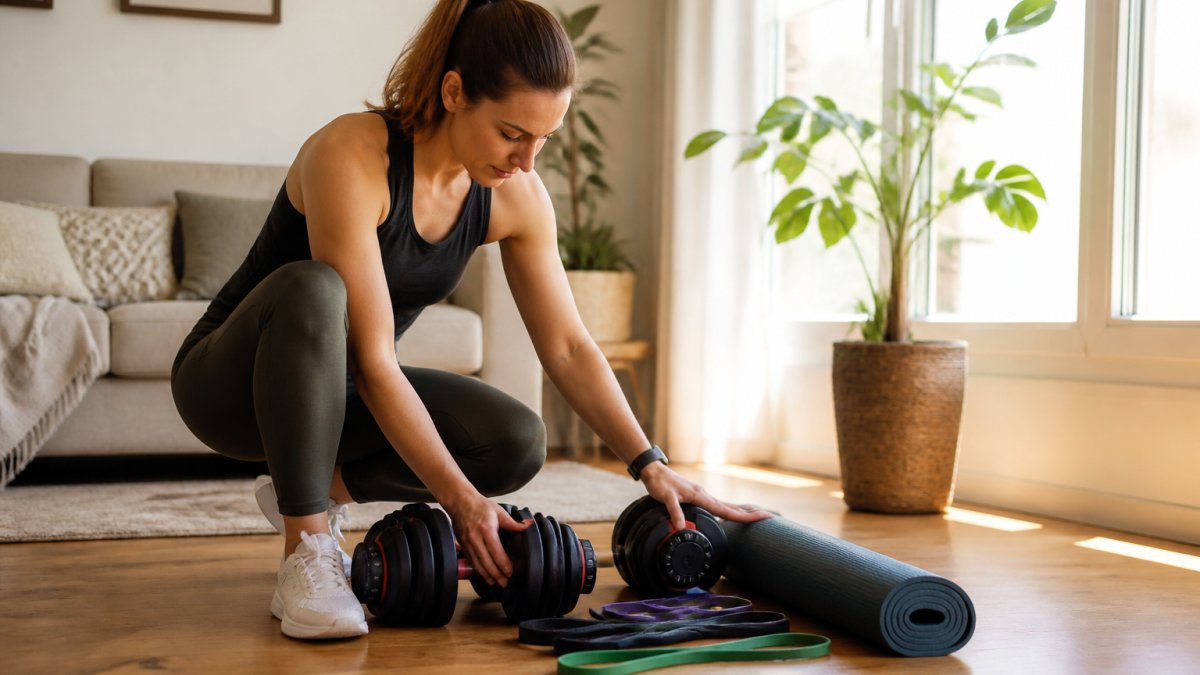
The best home gym equipment for beginners is a set of adjustable dumbbells, two or three resistance bands, and a flat bench or sturdy step. That combination covers every major muscle group and costs far less than a single year of gym membership.
Essential Equipment: Dumbbells, Bands, and a Bench
Adjustable dumbbells are the single best purchase for a home lifter. One pair replaces an entire rack and lets you apply progressive overload without buying new weights every month.
- Adjustable dumbbells: Your primary tool for presses, rows, squats, and lunges. Buy a pair that spans a wide weight range so you don't outgrow them.
- Resistance bands: Cheap, portable, and ideal for warm-ups, glute work, and adding tension when dumbbells feel light. Loop bands and tube bands serve different purposes.
- A flat bench or step: Enables chest presses, supported rows, and split squats. A sturdy bench also doubles as a seat for seated overhead presses.
- A mat: Protects your floor and gives you a defined training zone. Any dense exercise mat works.
Small-Space Setup Tips
Small-space optimization is one of the areas most beginner guides skip entirely. You can run a complete strength program in roughly two square metres if you choose the right movements.
Beginner Weightlifting Routine for Home
A beginner weightlifting routine for home should train the full body three times per week, with at least one rest day between sessions. This frequency gives each muscle group enough stimulus to grow while leaving room for recovery.
Sample 3-Day Full-Body Plan
Run this on non-consecutive days, for example Monday, Wednesday, and Friday.
| Day | Focus | Exercises | Sets x Reps |
|---|---|---|---|
| Day 1 | Full body A | Goblet squat, dumbbell bench press, bent-over row, plank | 3 x 8-12 |
| Day 2 | Full body B | Romanian deadlift, overhead press, split squat, band pull-apart | 3 x 8-12 |
| Day 3 | Full body C | Reverse lunge, floor press, single-arm row, dead bug | 3 x 8-12 |
How to Progress Without Heavy Weights
Progressive overload without heavy equipment comes down to manipulating variables other than load. When a set of 12 feels easy, you have four levers to pull before you need heavier dumbbells.
- Add reps. Move from 3 x 8 to 3 x 12 before adding weight.
- Slow the tempo. A three-second lowering phase makes the same weight much harder.
- Shorten rest. Cutting rest from 90 to 60 seconds raises the demand on muscular endurance.
- Switch to a harder variation. Elevate your feet, switch to a single-leg version, or add a pause at the bottom.
Proper Form and Technique for Home Lifting
Proper form is the difference between building muscle and building an injury. Two principles cover most of it: keep a neutral spine, and control the weight on the way down as carefully as you lift it.
Three cues that fix most beginner form problems:
- Brace your core before every rep, as if bracing for a light punch. This protects your lower back.
- Keep your wrists stacked over your forearms on presses, rather than bent back.
- Drive through your whole foot on squats and lunges, not just your toes.
How to Track Strength Training Progress
Tracking strength training progress means recording three things every session: the exercise, the weight or band tension, and the reps completed. Without this record, you cannot tell whether you are actually getting stronger.
Common Weightlifting Mistakes for Beginners
The most common weightlifting mistakes for beginners are progressing too fast, skipping warm-ups, and training through joint pain. Each one is easy to fix once you know to watch for it.
- Ego lifting. Choosing a weight that compromises your form. Drop the load and own the movement first.
- Training every day. Muscle grows during recovery, not during the session. Take rest days.
- Neglecting the cool-down. A few minutes of stretching and easy movement after training helps you stay consistent.
- Changing programs every week. Pick a plan and run it for at least six to eight weeks before judging results.
- Ignoring unilateral work. Single-arm and single-leg exercises expose and correct strength imbalances that two-limbed lifts hide.
Staying Consistent and Motivated at Home
Consistency beats intensity for beginners, and the psychological barriers to home training are real in a way gym guides rarely acknowledge. No one is waiting for you. No class starts without you. The sofa is two metres away, and the fridge is closer. Working out alone at home means you are simultaneously the athlete, the coach, and the person who has to decide to show up.
The Activation-Energy Principle
Every session has a startup cost: getting changed, clearing space, finding equipment, deciding what to do. The higher that cost, the more likely you are to skip. So attack the cost directly:
- Decide the night before. Write tomorrow's session on a sticky note, exercise, sets, reps. Decision fatigue is a bigger obstacle than physical fatigue for most beginners.
- Sleep in your training clothes if your session is first thing. It sounds silly; it works.
- Keep equipment visible. A rolled mat in the corner and dumbbells on the floor beat a neatly packed closet every time.
- Shrink the minimum. On low-motivation days, commit to five minutes. Most sessions that start at five minutes finish at twenty.
Fitting 20-Minute Sessions Into a Work-From-Home Day
Integration with daily life is what makes home lifting stick, and the work-from-home schedule is the biggest advantage you have, if you use it deliberately. Three windows work well for most people:
- Before your first meeting. A 20-minute session at 7:30am, before email, before Slack. You train while your willpower is untouched.
- The lunch break. Block 30 minutes: 20 minutes of training, 10 minutes to shower and eat. Treat it like a meeting you can't move.
- The transition window. Right after you close your laptop, before dinner. This uses the end-of-work boundary as a trigger rather than fighting it.
Process Goals Beat Outcome Goals
Outcome goals, 'lose 5kg', 'get stronger', are things you can't control week to week, so they're a poor motivator early on. Process goals are things you can hit today:
- 'Train three times this week.'
- 'Add one rep to my goblet squat.'
- 'Film one set and check my form.'
When You Miss a Session
The rule is simple: never miss twice. One skipped session is noise. Two in a row is the start of a pattern. If you miss Monday, Tuesday's session is non-negotiable, even if it's the five-minute version. The goal is not a perfect record; it's keeping the habit alive long enough for it to become automatic.
Frequently Asked Questions
How should a beginner start lifting weights at home?
Start with bodyweight exercises like squats and push-ups to build a foundation, then add light dumbbells or resistance bands. Aim for two to three full-body sessions per week, focusing on compound movements such as goblet squats, rows, and presses. Keep reps between 8 and 12, and rest 60 to 90 seconds between sets. Increase weight gradually once you can complete all sets with good form. Consistency matters more than intensity in the first month.
What equipment do I need to start lifting weights at home?
You need a set of adjustable dumbbells or a few pairs of fixed dumbbells, a resistance band, and a mat. A bench or sturdy chair helps for presses and rows. For small spaces, resistance bands and a single set of adjustable dumbbells cover most exercises. You do not need a barbell or squat rack to begin. Focus on equipment that lets you progress the load over time without taking up much room.
How often should a beginner lift weights to see results?
Two to three sessions per week is enough for beginners. Your muscles need 48 hours to recover between sessions, so avoid lifting the same muscle groups on back-to-back days. A Monday-Wednesday-Friday schedule works well. You will notice strength gains in three to four weeks and visible muscle changes in six to eight weeks if you stay consistent with your beginner weightlifting routine for home.
How do I track my progress without a personal trainer?
Log every workout: exercise name, weight used, reps completed, and sets. Use a notebook or a fitness app to record this. Each week, try to add one rep or a small amount of weight to at least one exercise. Take photos every two weeks and measure your arms, chest, and thighs monthly. Tracking how to track strength training progress this way shows you concrete evidence of improvement, which keeps you motivated when the scale does not move.
Starting a home strength habit is less about equipment and more about structure. Most beginners stall because they don't know what to do next, not because they lack motivation. DailyStrength solves that by generating varied, targeted workout plans from nearly 400 exercises, tracking your progress session by session, and adapting to your specific muscle group goals whether you train at home or in a gym. Get started with DailyStrength and turn scattered workouts into measurable strength gains.